Permission to Feel Overwhelmed
A weekly letter for the people who carry the most.
Hi friend,
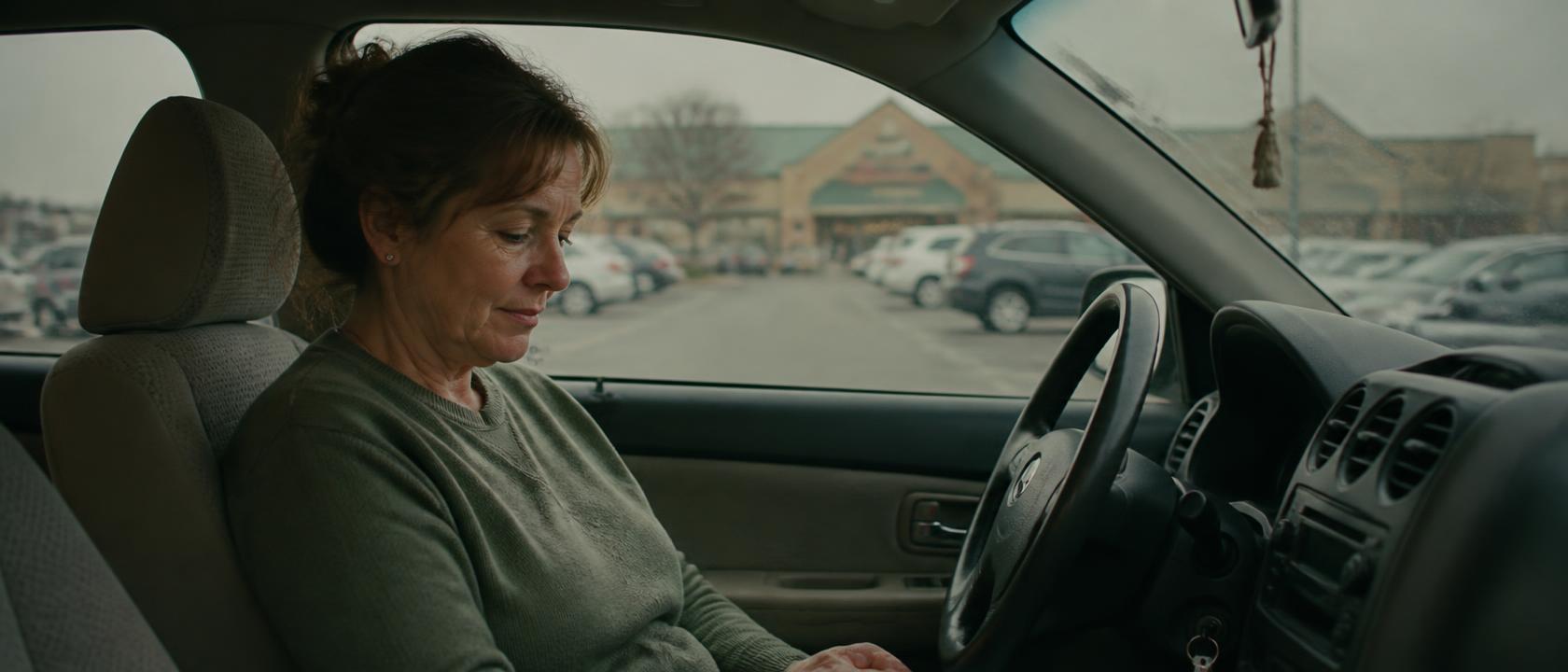
There is a version of this that happens in a parked car.
You made it through the appointment. You made it through the phone call with the insurance company, and the third try at the pharmacy, and the moment in the kitchen where you said something sharper than you meant. You made it to the grocery store parking lot with a list in your hand.
And then something small goes wrong. The cart has a bad wheel. The card reader will not read. Somebody takes the space you were waiting for.
And you sit down in the driver's seat and cry about a shopping cart.
I want to say something to you before we go one inch further, because I think you have been carrying the wrong explanation for that moment.
You were not crying about the cart
And you are not falling apart. Something in you finally found a small enough thing to put it down on.
What the number actually says
Let me give you a number, not to alarm you, but because I have watched this particular number change how people see themselves.
In A Place for Mom's 2025 Caregiver Survey, a national survey of 1,029 family caregivers fielded in September 2025, 78 percent of caregivers reported experiencing feelings of burnout, and many described it as a weekly or even daily occurrence.
Feelings of overwhelm were almost as common. 84 percent reported it overall, and nearly half experienced it weekly.
Sit with the shape of that for a second. Not one in ten. Not the ones who are handling it badly. Nearly eight in ten.
Here is what a number that large actually tells you. When almost everyone doing a thing has the same reaction to it, the reaction is not the problem. The thing is.
You have probably been treating your overwhelm as evidence about you. Evidence that you are not organized enough, not patient enough, not strong the way your mother was strong. That is what it feels like from inside, because from inside you can only see your own kitchen.
But eight out of ten people in their own kitchens feel exactly the same way. That is not a character trend. That is a load report.
You are doing the work of a team
There is a reason the load is what it is, and somebody said it out loud in front of the United States Senate last winter.
Jason Resendez, President and CEO of the National Alliance for Caregiving, testified before the Senate Special Committee on Aging in December 2025. In his written testimony he put it this way:
"Family caregivers deliver comprehensive, complex support that would otherwise require teams of paid professionals."
Teams. Plural.
Read your own week back through that sentence. In a facility, the tasks you did this week would have been divided among a nurse, a med tech, a scheduler, a social worker, a housekeeper, a driver, an aide, and someone at a desk whose entire job is insurance. Each of them clocks out. Each of them has a supervisor to ask. Each of them goes home to a house where nobody is calling their name at two in the morning.
You are all of them. You are all of them at once, in the same body, with no shift change and no one to ask.
You are not failing. You are outnumbered.
And there is one more piece of this that almost nobody says to caregivers, so I will. In Mental Health Impacts of Family Caregiving, the March 2026 research brief from AARP and the National Alliance for Caregiving, 56 percent of caregivers said they felt they had no choice in taking on their role.
More than half. You did not apply for this. Most people in this with you did not either. Love is not the same thing as consent, and needing the job to be lighter is not the same thing as loving the person less.
Patrice's version of this (a composite, drawn from the situations readers write to me about, not one real person): for eleven months she told everyone she was fine, and she believed it, because she was getting everything done. Then she cried in a parked car about a shopping cart, drove home, and told her sister she was probably getting sick. It was another four months before she said the true sentence to anyone, which was not "I need a break." It was smaller than that. It was, "I do not think I can keep doing this the way I am doing it."
Nothing collapsed when she said it. That is the part she tells people now. She had been carrying the sentence for over a year because she thought saying it would break something, and when it finally came out, her sister said, "Yeah. I have been waiting for you to say that."
What you think it means
- "I cried over a shopping cart, so I am losing it."
- "Other people manage this. Something is wrong with me."
- "If I were more organized, I would not feel like this."
- "I should be grateful. Feeling this way makes me a bad daughter."
What it actually means
- Your body found a small enough thing to set the weight down on.
- Nearly eight in ten people doing this feel the same way.
- The load is not a filing problem. No system carries this for you.
- Gratitude and exhaustion live in the same person at the same time. Both are true.
Source: A Place for Mom, 2025 Caregiver Survey (n = 1,029, fielded September 2025)
Five things to say to yourself in the parked car
- 1"This is not about the cart." Name the real size of it. You are not overreacting to a small thing. You are reacting, finally, to a large one.
- 2"I am allowed to be here for a minute." You are not late to anything that matters more than this. Ten minutes in a parked car is not a lapse. It is maintenance.
- 3"Tired is information, not a verdict." It is telling you the load is too heavy for one person, which it is. It is not telling you who you are.
- 4"I can love her and still want this to be lighter." Both are true at the same time. Wanting relief is not a betrayal, and it never was.
- 5"One true sentence, to one person, sometime this week." Not a plan. Not a request. One sentence out loud, so you are not the only one who knows.
Save this. The next parked car is not an emergency. It is just where the honesty finally fits.
The National Institute on Aging says this plainly in its own caregiver guidance: "the ongoing demands of taking care of someone else can strain even the most resilient person." It also names the regret it hears most: "Many caregivers later say they did too much on their own, and they wished they had asked for more support from family and friends." Not the ones who did too little. The ones who did too much alone. (National Institute on Aging, "Taking Care of Yourself: Tips for Caregivers," content reviewed October 2023.)
Wherever you are standing in this
Overwhelm does not look the same from every seat, and it helps to know that the person across from you is carrying a version of it too.
If you carry the daily care, yours is the overwhelm of no edges. There is no end of shift, so there is no moment when the weight is officially allowed to be set down. Your permission this week is the plainest one: you are allowed to be exhausted by something you chose to do, and you are allowed to be exhausted by something you did not choose.
If you live nearby, yours is the overwhelm of the phone. You are half on call at all times, which is its own kind of tired, and because you are not the primary you may feel you have not earned the right to be worn out. You have.
If you are the one far away, yours is the overwhelm of the imagination. You carry the whole situation in your head with none of the information in front of you, and distance turns every silence into a scenario. Guilt is heavy in a way that is hard to explain to people who can drive over.
Three different weights. Nobody in the family is doing this easily. When one of you finally says a true sentence out loud, it usually turns out the others were waiting for permission to say theirs.
Why this matters for the person you love
Here is the part that is not about your feelings.
Overwhelm is not just uncomfortable. It is expensive, and the person who pays part of the bill is the person you are caring for.
A depleted caregiver misses things. Not through carelessness, but because attention is finite and yours is spread across two households and a hundred small decisions a day. Exhaustion is where the missed dose lives. It is where the appointment gets rescheduled a third time, where the new symptom gets filed under "probably nothing," where patience runs out ten minutes before bedtime and the evening ends badly for both of you.
And there is the longer arithmetic. This is not a sprint you can white-knuckle. Most people do this for years. A caregiver who is running on nothing does not get to keep doing it, and the alternative arrangement is almost never the one anybody wanted.
So the honest case for taking your own overwhelm seriously is not that you deserve to feel better, though you do. It is that your steadiness is a piece of infrastructure in someone else's life. Looking after it is part of the job, not a break from it.
The truth
Being overwhelmed is not a report card on how well you love someone. It is a reading on how much you are carrying without relief, and readings are meant to be acted on, not apologized for.
The number
family caregivers report having trouble sleeping at least once a week. Half. So if you have been quietly wondering whether you are handling this badly because you are tired all the way to the bone, please hear this: the tiredness is not evidence against you. It is the most common condition in the room.
Source: A Place for Mom, 2025 Caregiver Survey
The small step
Take one thing off this week's list and do not do it.
Not something for your loved one. Something of yours: the returns, the thank-you note, the thing you keep moving to Thursday. Cross it out, or say it out loud so it counts, and let the week be one item shorter.
This one is not about coping better. This one is about carrying less.
If you need somewhere to turn this week
Resources matched to today's topic. You do not have to carry this alone.
Free government guidance on caregiver stress, including the warning signs and the plain permission to take a break. It is short, and it is written without a single guilt trip.
Available 24/7/365. It is not only for the worst moment. It is for "mental health struggles, emotional distress, alcohol or drug use concerns, or just need someone to talk to," in their own words. Conversations are free and confidential.
Administered by USAging and funded by the Administration for Community Living. Open Monday to Friday, 8:00 am to 9:00 pm Eastern. The fastest route to real help in your loved one's own town, including services that take work off your plate.
A free Caregiver Help Desk, staffed by people whose whole job is helping caregivers figure out the next step.
Before you go
I do not think you need to be talked out of feeling overwhelmed. I think you need somebody to confirm the reading.
So here it is, plainly. The load you are carrying would be divided among a team of paid people almost anywhere else it existed. More than half the people doing it never chose it. Nearly eight in ten of them feel exactly what you feel. You are not soft, and you are not behind, and you are not doing this worse than the people who look like they have it together.
You are one person doing the work of several, in a role nobody trained you for, for someone you love, and it is heavy because it is heavy.
That is all the parked car ever meant.
With you in it,
P.S. Next week we start Season 2, and we start it with the question that scares most families more than they admit: what does "in-home care" actually mean, what does it cost, and does letting someone into the house mean you have failed at this? Spoiler on that last one. It does not. If you have been quietly wondering whether it is time to look, that one is especially for you.
The journey is too much for one person. It was always going to be. You are not walking this alone.
A quiet Sunday letter for caregivers
Free. One letter a week. Unsubscribe anytime.