A weekly letter for the people who carry the most.
CBy Cherith
Hi friend,
The question always comes at the worst possible moment.
It is late. Someone in scrubs is standing in front of you with a clipboard, or a voice on the phone is being very patient with you, and they ask something simple. What is she taking. What dose. Who is her cardiologist. When was the last time she had that test.
And you know. You absolutely know. You have known it a hundred times this year. But right now your mouth says, "There is a blue one," and then you hear yourself start to apologize.
Here is what I want you to understand about that moment: nothing is wrong with your memory. You are being asked to recite clinical information under stress, from memory, with no chart in front of you, in a role nobody trained you for.
That is not a personal failing. That is a system problem, and it has a paper solution.
It is not that you forgot
Let me put a number under that hallway moment, because the number changes how it feels.
In Caregiving in the U.S. 2025, the national study from AARP and the National Alliance for Caregiving, caregivers were asked about medical and nursing tasks: things like managing catheters, giving injections, monitoring vital signs. More than half of family caregivers, 55 percent, do those tasks. Only 22 percent received any training for them.
Read the second number again. Twenty-two percent.
And it is not only the clinical work. The same report found that for the ordinary daily tasks, the bathing and dressing and meals and finances, only 11 percent of caregivers received any formal training at all.
So think about what that actually means about your kitchen table. You are doing skilled work, on someone you love, with real consequences, and you learned it by watching, guessing, and reading at midnight. Then somebody hands you a clipboard and expects you to have the chart in your head.
You are not disorganized. You are undersupplied.
A care binder is not one more chore on a list that is already too long. It is the supply. It is the manual nobody gave you, written by the only person who actually has all the pieces.
What the vigilance is costing you
There is a specific kind of tiredness that comes from being the only copy of the information.
It is the mental tab you can never close. It is why you cannot fully relax at your kid's game, why you wake at three and mentally re-check the pill organizer, why a phone call from an unknown number makes your stomach drop. You are not just doing the tasks. You are holding the whole file open, all the time, because if you set it down nobody else can pick it up.
Susan Reinhard, a registered nurse and, at the time, senior vice president and director of the AARP Public Policy Institute, said this plainly back in 2019, when AARP released its study of caregivers doing complex medical work at home:
"This report shows the extent of complex tasks that millions of family caregivers are providing every day. They are largely alone in learning how to perform these tasks. About half of family caregivers are worried about making a mistake."
Susan Reinhard, RN, PhD · AARP, April 2019
Largely alone in learning how. And about half, worried about making a mistake.
Writing about that same study, Reinhard added a sentence worth taping inside your cabinet door: "The more complex the tasks they perform, the more they feel stress, worry, and pressure to be vigilant."
Pressure to be vigilant. That is the thing nobody names, and it is the thing a binder actually treats. Not the workload. The vigilance. Every fact you write down once is a fact your brain is allowed to stop guarding.
Renee's version of this (a composite, drawn from the situations readers write to me about, not one real person): she kept everything in her head for two years and was proud of it. Then she got the flu the same week her mother had a fall, and a cousin who genuinely wanted to help stood in her mother's kitchen and could not answer one single question. Renee built the binder that weekend, from bed, in about ninety minutes. She says the strange part was not how useful it was to the hospital. It was how much quieter her own head got.
You are not disorganized. You are undersupplied.
The same phone call, two ways
11:40 p.m., without it
"What is she taking?" "There is a blue one."
Three calls to two siblings. Nobody is sure.
The nurse writes "unknown" on the form.
You lie awake rewriting the answer you should have given.
11:40 p.m., with it
You open tab two and read six lines out loud.
Dose, times, prescriber, pharmacy, allergies.
The nurse says thank you and moves on.
You sleep, because there was nothing left to remember.
55%of family caregivers handle medical or nursing tasks
22%received any training for them
11%received any formal training for daily care tasks
Source: AARP and the National Alliance for Caregiving, Caregiving in the U.S. 2025 (pages 2 and 28)
Save this for the next time somebody asks you a dose
The care binder: six dividers, one page each
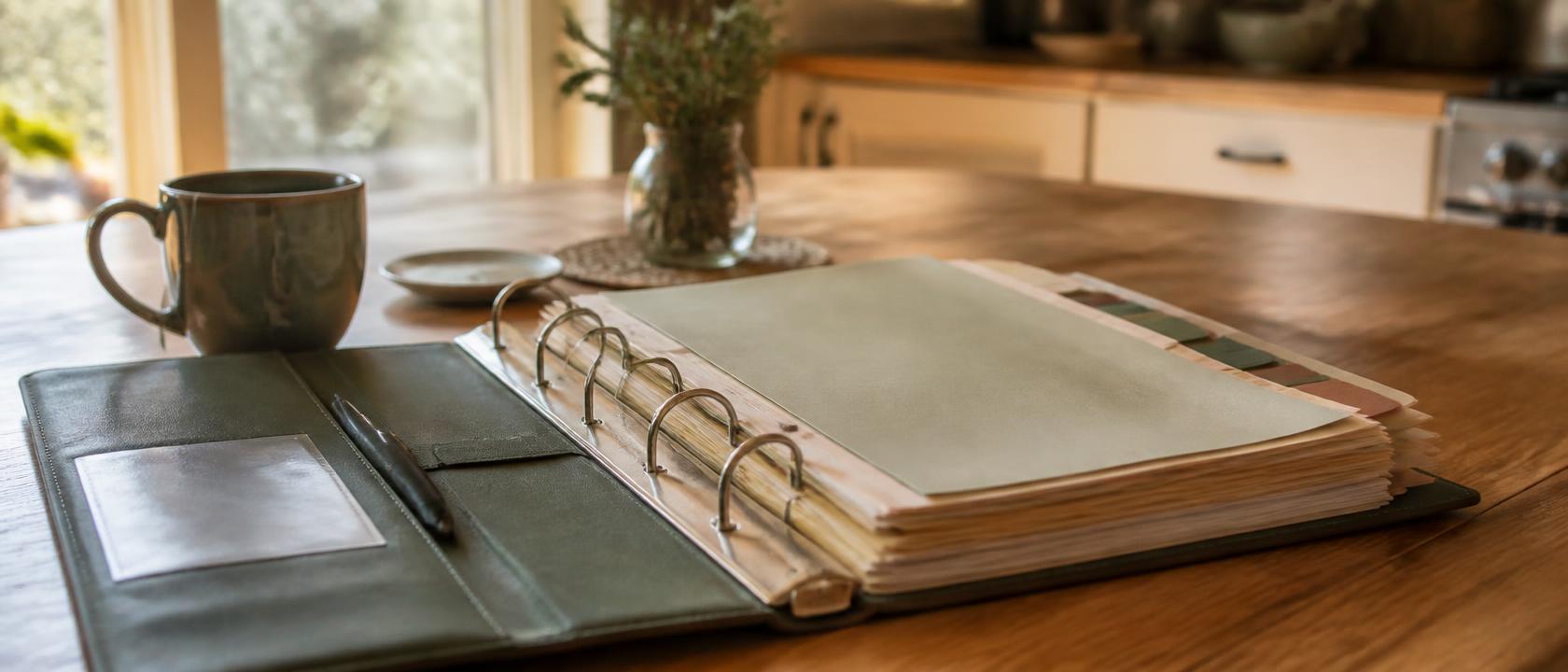
One three-ring binder from the grocery store. Six dividers. One page behind each. That is the whole thing, and you do not build it in one sitting.
1The one-page summary. Full legal name, date of birth, conditions, allergies, blood type if you know it, emergency contacts, and who holds medical decision-making authority. If a stranger could only read one page, this is the page.
2Medications. Every prescription and every over-the-counter and supplement, with dose, times, and prescriber. Take a photo of the bottles today and type it up later. The photo counts as progress.
3Doctors and pharmacy. Every provider, specialty, phone, portal login location, and the pharmacy with its phone number. Add who to call after hours.
4Insurance and ID. Front and back copies of the insurance cards, Medicare or Medicaid numbers, and a copy of a photo ID.
5Legal documents. Not the originals. A note saying which documents exist, who has them, and where. Power of attorney, health care directive, will.
6The log. One line per event. Date, what happened, who you talked to, what they said. This is the divider people skip and later wish they had started.
Save this. Then do divider two, medications, and stop for the week. That is a complete win.
The National Institute on Aging, in its own guidance on organizing this kind of information, gives you permission to keep it low-tech: "You can set up a file, put everything in a desk or dresser drawer, or list the information and location of papers in a notebook." It also adds the part families forget: "Someone you trust should know where to find your papers in case of an emergency." A perfect binder nobody can find is not a binder. (National Institute on Aging, "Getting Your Affairs in Order Checklist," last reviewed February 2023.)
Who builds it, and one job for everyone
This is a rare caregiving task that splits cleanly across the whole circle, which almost nothing does.
If you carry the daily care, you do not build this. You are the only one who cannot spare the ninety minutes. Your job is the log, one line a day, and answering questions somebody else types up.
If you live nearby, you are the eyes. Photograph the pill bottles, the insurance cards, the front of the mail nobody opened. Fifteen minutes in the house is worth two hours of guessing.
If you are the one far away, this is yours. You have the quiet, the laptop, and the clear head that nobody standing in that kitchen has. Build the binder, keep it current, and mail a printed copy back to the house so there is one at the bedside and one with you. Last week I said distance hands you jobs nobody in the room has time to do. This is the first one on the list.
Nobody has to become the family's secretary. One person builds it. Everybody feeds it.
Why this matters for the person you love
Here is the part that is not about tidiness.
The person you care for gets a measurably different level of care depending on whether the information arrives with them. The dose that gets confirmed instead of guessed. The allergy that gets caught. The specialist who finally sees the whole picture instead of the last six weeks. The hospital that discharges them with a plan somebody actually understood.
And there is a second thing, quieter and just as real. When the information lives in one place instead of only in you, you become interruptible. You can get the flu. You can go to your own appointment. You can hand off an afternoon without the whole structure wobbling, because the structure is no longer made out of your memory.
That is the trade this week offers. Ninety minutes of paperwork, spread over a few sittings, in exchange for a version of you who is allowed to be a person sometimes. Your loved one needs you steady for a long time. Steady requires that you be replaceable for an afternoon.
Your steady hand this week
The truth
You are one of the people in this story who needs care. Not the loudest need in the house, maybe. But one of them, and you are allowed to be on the list.
Nearly 1 in 4
The number
family caregivers say they have difficulty caring for themselves. You keep a record of everyone else's dosages and appointments. Almost nobody is keeping one of yours, and that is not a character flaw. It is just what happens when the list has no line for you.
Source: AARP and the National Alliance for Caregiving, Caregiving in the U.S. 2025
The small step
Pick the one thing of your own that you keep sliding to next week. The dentist. The oil change. The prescription of yours that never got refilled.
Do only the first two minutes of it: find the phone number, and put it somewhere you will see it. Not the appointment. Just the number.
This one is not for the binder. This one is for you.
If you need somewhere to turn this week
Resources matched to today's topic. You do not have to carry this alone.
I verify these before every issue. If a link or program has changed, I will let you know.
Before you go
You have probably been told, by someone who meant well, that you should get organized. It landed like criticism, because it always does.
So let me say it the true way instead. You are not behind on your filing. You are a person doing skilled medical work with no manual, no training, and no chart, holding an entire human life in your memory because nobody handed you anywhere else to put it.
Put it down. Not the love. The load.
One binder. Six dividers. Start with the medications, and let that be enough for this week.
With you in it,
C
Cherith
The Steady Hand
P.S. Next week is the one I suspect you need most, and it has nothing to do with paperwork. "Permission to Feel Overwhelmed" is about the day it all lands on you at once and you find yourself crying in a parked car over something small. If you have ever wondered whether you are handling this badly because you are tired all the way to the bone, that one is especially for you. Bring nothing. Just read it.
You do not have to hold it all in your head. You are not walking this alone.