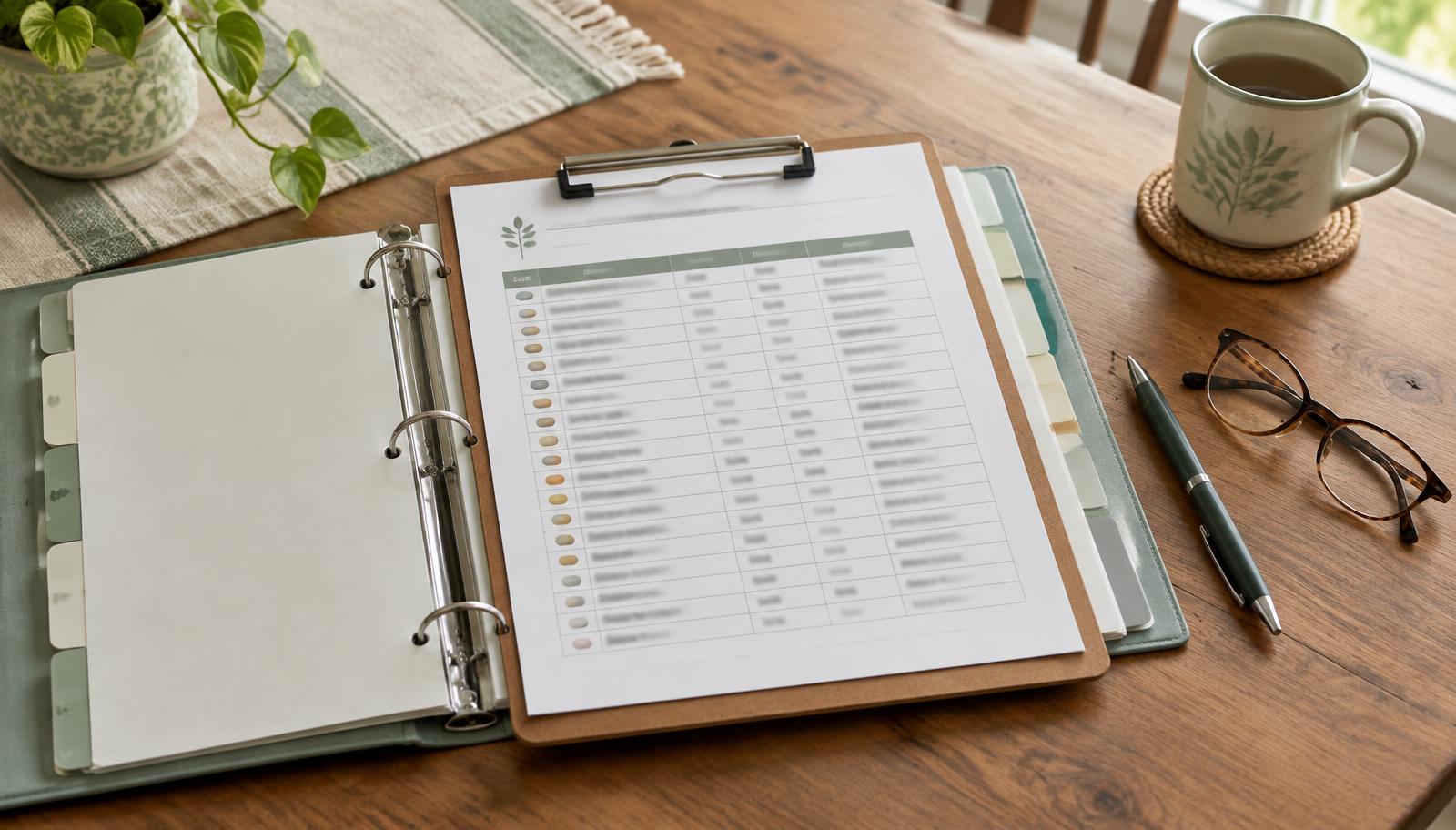
The one list you get asked for in every single room, whether keeping it on your phone counts, and the single page that makes a hospital visit shorter.
CBy Cherith
Hello friend,
Someone is going to ask you what she takes.
It will be a nurse with a clipboard, or a pharmacist on the phone, or a receptionist who cannot start the appointment without it. And you will do the thing you always do. You will recite from memory. You will get four of them right, and then you will hear yourself say there is a little white one, and you will watch the pen stop.
That moment is not a memory problem. It is a storage problem, and it has a fix that fits on one sheet of paper.
The list they ask for in every single room
There is one document that follows you everywhere. Not the insurance card. Not the power of attorney. The medication list.
It gets asked for at the primary care visit, the specialist visit, the dentist, the eye doctor, the pharmacy, the emergency room, the pre-op call, the home health intake, and the day program application. Same list. Nine times. And each time it comes out of your head instead of out of your hand.
55 percent of family caregivers help with giving medicine, pills, or injections.
That is the National Alliance for Caregiving and AARP, in Caregiving in the U.S. 2025, counting caregivers of adults eighteen and older. Not managing a pharmacy. Not nursing. Just the ordinary daily act of handing someone what they are supposed to take and knowing it was taken.
A figure like that means something simple and uncomfortable. An enormous number of us are carrying a list that exists nowhere but in our own working memory. And a list that lives only in your head cannot be handed to anybody, cannot be read while you are asleep, and cannot be checked by the person who takes the Thursday shift or the brother who gets the midnight call from six hours away.
“About half of family caregivers are worried about making a mistake.”
Susan Reinhard, RN, PhD · then Senior Vice President and Director, AARP Public Policy Institute · quoted by AARP, April 17, 2019
The research she was describing is seven years old now, and the worry is not.
Read that again, because it is not a criticism. It is a description of what it costs to be the only copy.
The pile is not a problem
If you started a binder in August and it is now a pile, nothing has gone wrong. A pile is what a binder looks like while it is still being written. Every real system starts as a heap of paper somebody has not sorted yet.
What goes wrong is different. What goes wrong is building the beautiful binder and then discovering that in the rooms where it matters, nobody wants a binder. They want one page, and they want it in under a minute, and they usually want it while you are also holding a coat and a phone and a person.
Nobody is going to read your binder. Somebody will read one page.
Does the phone count?
A lot of families have quietly moved everything onto a phone, and nobody has told them whether that is fine.
41 percent of caregivers of adults age 50 and older use technology or software to track their recipient’s personal health records. That is the National Alliance for Caregiving and AARP, in Family Caregivers of Adults Age 50-Plus, published in July 2026. So if your system is a note on your phone, you are not behind. Plenty of families are already there.
Here is the honest answer about whether it counts. Your phone is a very good library and a very bad handout.
It is a good library because it is always with you, it is searchable, it updates in two seconds standing in a pharmacy line, and it holds photographs of the actual bottles, which is worth more than typing out the names. Take the photographs. Take them today.
It is a bad handout for four plain reasons. It dies. It locks. It cannot be left behind in a room with somebody who needs to copy from it. And it is useless on the day you are not the person standing there, which is the whole day the binder was built for.
So do not choose. Keep the phone as the library and print the page as the handout. The page is a snapshot of the library, taken whenever something changes, and it costs one sheet of paper.
The one page that makes a hospital visit shorter
Jason Resendez, President and CEO of the National Alliance for Caregiving, testified before the Senate Special Committee on Aging in December 2025. Describing what families recognize, he talks about a father’s recent fall, the time spent in the hospital, and then the discharge home, where he suddenly needs help bathing, dressing and preparing meals. That whole sequence, from the fall to the help at home, is documented in a handful of rooms you will be standing in, asked to supply information, under the worst conditions of your year.
Medicare publishes a free document for exactly this, and almost nobody has seen it. It is called Your discharge planning checklist, revised in December 2025. It is written to the patient, but it names you in its opening line, as “a family member or friend who may be helping you.” Page five of it is a blank drug list, and the checklist tells you to use that list to write down the full list of prescription drugs. Then two instructions, word for word: “Include items that you took at home, and note any changes or additions during your stay.” And “Share this updated drug list with your health care providers.”
That is the whole secret. The page is not a filing achievement. It is a thing you hand across a counter so the conversation can skip the first ten minutes.
Save this
Six lines that travel
1
Who, and when they were born. Full legal name and date of birth, because that is how every system finds her.
2
What she takes. Name, dose, how often, and what it is for. If you only know what the bottle looks like, write that down too. It is better than nothing and somebody can work from it.
3
What she cannot take. Allergies and bad reactions, including the vague ones. “Something in 2019 made her itch” is a real entry.
4
Her conditions and her surgeries, with rough years. Nobody expects exact dates.
5
Her doctors, with a phone number each, and which one is the main one.
6
You. Your name, your phone number, your relationship, and the second person to call if they cannot reach you.
One page. Print four. One in the binder, one in the glove box, one in the bag that goes to appointments, one taped inside a kitchen cabinet door where a paramedic would find it. Update it in pen. Reprint it when the pen runs out of room.
The one page
A facsimile of the single sheet, with the six fields laid out as blanks.
Medication and emergency page · Updated ____________
Name / date of birth
Medicines and doses
Allergies / reactions
Conditions / surgeries
Doctors and numbers
Caregiver and backup
55%
of family caregivers help with giving medicine, pills, or injections.
NAC and AARP · Caregiving in the U.S. 2025
41%
of caregivers of adults 50 and older track their recipient’s personal health records with technology.
NAC and AARP · Family Caregivers of Adults Age 50-Plus, 2026
Why this matters for the person you love
Rani E. Snyder, Program Director at The John A. Hartford Foundation, said it plainly when that 2019 research came out.
“Family caregivers are the linchpin in our health care system, particularly for older adults.”
Rani E. Snyder · Program Director, The John A. Hartford Foundation · quoted by AARP, April 17, 2019
Linchpin is the right word and it is not a compliment so much as a load rating. You are the part the whole assembly turns on. Every clinician who sees your person sees one slice of her, on one day, with one set of questions. You are the only one holding the continuous version.
Which means your memory is clinical equipment. When it is tired, the information that reaches the people treating her is thinner, and thinner information produces more cautious and slower care. Not worse people. Worse inputs.
The page is how you stop paying for that with your own recall. Write it down once and the system can read it even on the night you cannot think straight, and you get to go back to being her person in the room instead of her filing cabinet.
Your steady hand this week
That binder has a page for everything she needs. Nobody has ever sat you down and asked you to make one for what you need.
16%
Only 16 percent of sandwich generation caregivers, the ones raising children while also caring for an adult, report that a health care provider has asked them what they need.
AARP, with the National Alliance for Caregiving, Caught in the Middle: The Crucial Role of Sandwich Generation Caregivers, September 2026. The figure describes that group specifically and not all caregivers. It counts what people said happened to them, which is the only way anyone could count it.
One small next step
Pick the one thing you would ask for, if somebody finally asked.
Not a list. One thing. An afternoon. A ride. A night where the phone is somebody else’s. Two minutes of deciding, and then you are allowed to put it down.
This one is not for the binder and you do not have to ask for it this week. Nobody has to say yes, because you are not asking yet. You are just finding out that you have an answer.
Three, not four. Two federal and one research. Nothing here sells anything and nothing here paid to be here.
Before you go
You were told to get organized, and you tried, and you ended up with a binder that is heavier than it is useful on the one night it gets carried.
You are not bad at systems. You built the archive first, which is the order everybody builds it in, and the archive is the part that takes two years. The handout is the part that takes twenty minutes, and it is the only part anybody will ever ask you for.
So this week is not about organizing anything. It is about making one page thin enough to hand to a stranger.
With you in it,
C
Cherith
The Steady Hand
P.S. Next week the problem stops being paper and starts being people. Issue 17 is Coordinating a Team: the shared tool families actually keep using after the second week, and why most of them are abandoned by then; who holds the master copy and what happens when two people edit it; and what to do when one sibling will not look at any of it. If you are the one who built the binder and nobody else has opened it, that issue is especially for you. You did not build it wrong. You built it alone.
May the thing you carry in your head find its way onto paper, and may the paper be waiting for you on the night you need it.