A Daily Routine That Holds
Why the same day in a different order costs you less, where the fog comes from, and what to do on the morning it all falls apart.
Hello friend,
There is an hour of the afternoon when you stop being able to decide things.
Somebody asks you something simple. Whether to thaw the chicken or just order something. And your brain hands back nothing. Not a wrong answer. Nothing. You stand in front of the open refrigerator for a while, and then you close it, and you do neither.
If you have been calling that tiredness, I want to give you a different word for it.
The thing you have been calling tiredness
About 1 in 8 unpaid caregivers who are 45 or older report worsening confusion or memory loss.
That is the Centers for Disease Control and Prevention, writing up its own study of survey data collected between 2015 and 2019.
Here is exactly what that is, because it is your brain and you deserve the edges of it and not just the headline. The measure is self-reported. Nobody was tested. Nobody was diagnosed. It is a count of how many people, asked directly, said yes, something has changed, I lose the thread more than I used to. It is not dementia. It is not a diagnosis. It is not a forecast about you.
It is documentation. Somebody counted the thing you have been apologizing for.
The same summary adds one more finding, and it is the one I keep coming back to: caregivers between 45 and 64 were more likely to report worsening memory loss than people the same age who were not caregiving. Same decade of life. Same ordinary forgetting that everybody jokes about. More of it among the people carrying somebody else’s day.
So when you walk into a room and cannot remember why, you are not failing at something other people are managing. You are running two lives on one set of working memory.
One thing before we go on. If the fog is getting worse, or if it frightens you, say it out loud to your own doctor at your own appointment. Not as an emergency. As a sentence. You are allowed to be the patient in a room where you are always the historian.
Two hundred easy decisions
Almost all of this is happening at home. About 80 percent of adults with Alzheimer’s disease and related dementias receive care in their homes, according to the CDC. Not in a building with a shift change and a whiteboard and a schedule somebody else wrote. In a kitchen. By a person with no training and no handover.
Which means everything a facility would decide once, in advance, on paper, you decide fresh. Every morning. Out loud. While being watched.
When breakfast happens at a different time every day, you decide breakfast. When the pills are sometimes before and sometimes after, you decide the pills, and then you decide whether you already did the pills. When the shower floats, you decide the shower, and then you decide how to bring up the shower, which is a second decision wearing the first one’s coat.
None of it is hard. That is what makes the cost invisible. It is all easy, and there are two hundred of them, and by four in the afternoon the easy ones have eaten the hard ones.
Which is why the order matters more than the content. The same day in the same order is a cheaper day than the same day in a new order. Not because the tasks shrink. Because the deciding does.
A routine is not a schedule. A schedule tells you what to do at 2:15. A routine takes the deciding out of the day and gives it to yesterday.
Two or three things that do not move
Most advice about routines hands you a grid with hours down the side, and you look at it already knowing your life will not survive contact with a grid. Somebody has a bad night. Somebody has an appointment. Somebody will not get dressed.
So do not build a grid. Build two or three fixed points, and let everything between them float.
A fixed point is one thing that happens at the same time every day no matter what else moves. One in the morning, one in the middle, one at the end. Three is plenty. Two is enough. The rest of the day is allowed to be weather.
Before you write anything down, the Alzheimer’s Association asks you to consider two things, and they are the right two. What times of day the person functions best. And how the person used to structure his or her day.
Read those again, because together they do something unexpected. You are not inventing a routine. You are recovering one.
Your father got up at five thirty for forty years. Your mother did the dishes before she sat down, every night, and she is not going to enjoy sitting down first now just because it would be easier for you. The shape is already in there. Your job is to find the two or three places where their old shape and their current capacity agree, and to nail the day down at exactly those points.
And one more line from that same guidance, because it undoes something you may be carrying: “Don’t be concerned about filling every minute with an activity.” An empty hour is not a planning failure. Sometimes it is the plan.
Three questions that find your fixed points
- 1
What hour is reliably their best hour? Not their favorite. Their most capable. Put the hardest thing there and stop trying to do it at other times.
- 2
What are they already doing at the same time every day without being asked? That is a fixed point you did not have to build. Protect it instead of rearranging it.
- 3
What is the one thing that, when it slips, wrecks the rest of the day? Pills, a meal, a nap, getting dressed. There is usually one. That one gets a time, in ink, and it does not move for anybody.
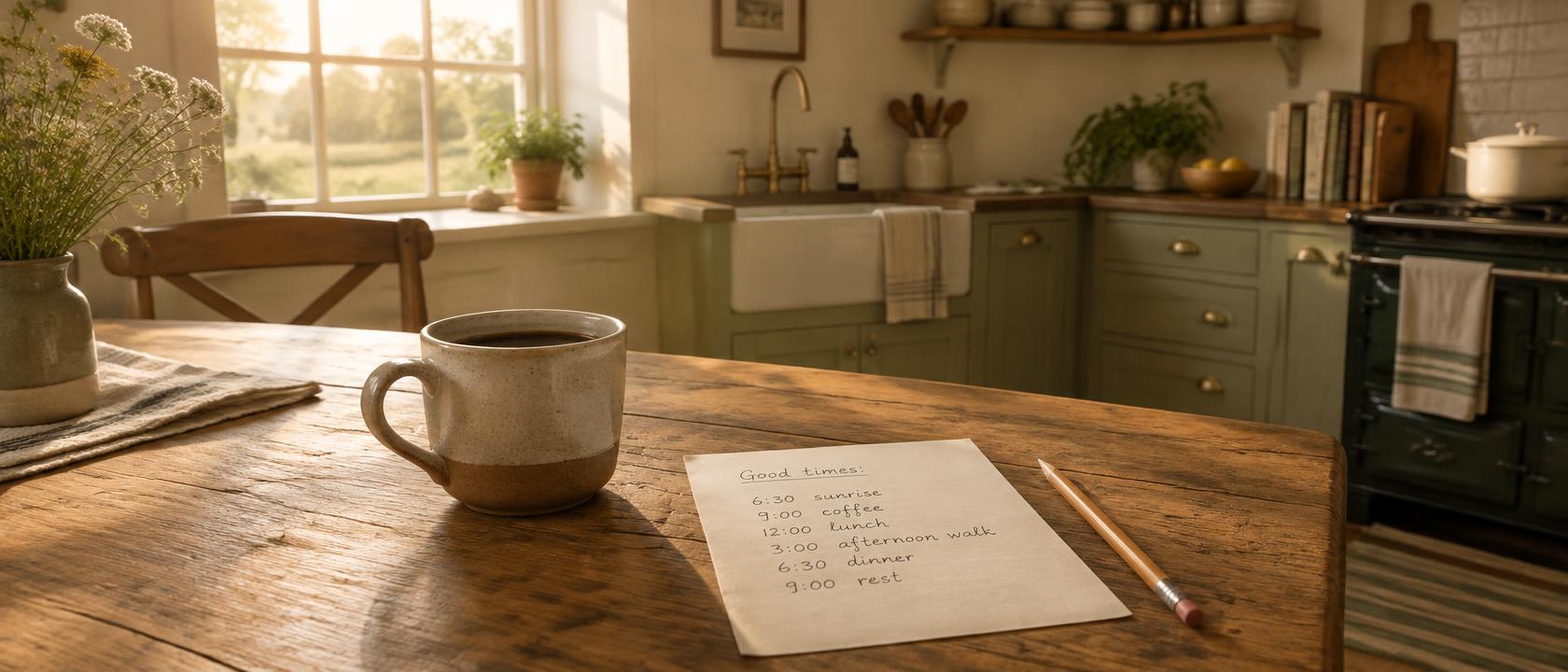
One sheet of paper, fifteen minutes at a kitchen table. You are not making a timetable. You are finding the two or three nails the day hangs on.
You are not scheduling the day. You are nailing it down in two or three places.
Everything between the nails is allowed to move
| About 1 in 8 | unpaid caregivers 45 or older report worsening confusion or memory loss. Self-reported · CDC · survey data 2015 to 2019 |
|---|---|
| About 80% | of adults with Alzheimer’s and related dementias receive care in their homes. CDC |
The morning it falls apart
It will. Probably Thursday.
Somebody will not sleep, or will not eat, or will be furious at you about something that happened in 1987, and the fixed points will go down like dominoes, and you will be standing in a day with no shape at all, feeling the particular despair of having finally organized something and watched it fail by nine in the morning.
Here is what I want you to do, and it is going to sound too small.
Do not rebuild the day. Rebuild the next fixed point.
You do not owe the day a recovery. You owe it one anchor. If the morning is gone, the morning is gone, and lunch is still at the time lunch is at. Walk to the next nail and start there. A routine that survives a bad morning is not one that prevented the bad morning. It is one with a next nail in it.
The Alzheimer’s Association says it this way: “Make sure to allow for flexibility within your daily routine for spontaneous activities.” And: “Planning activities for a person with dementia works best when you continually explore, experiment and adjust.”
Explore. Experiment. Adjust. Not get it right. There is no version of this where you get it right and it stays right, because the person you are caring for is changing, and a routine that fits them in October will not fit them in March. The adjusting is not proof you built it wrong. The adjusting is the routine.
Why this matters for the person you love
The CDC’s researchers put one sentence in their discussion that I have not been able to put down.
“SCD likely affects the quality and safety of care that caregivers can provide.”
That is not written to frighten you. It is written by people who count you as part of the care, which is a thing almost nothing in the medical system does.
Because the fog is not a private inconvenience. The fog is the hand on the pill organizer. It is the memory holding which doctor said what. It is the judgment that decides, at nine at night, whether this is a call-somebody thing or a wait-until-morning thing. When it thins out, the care thins out with it, and not because you stopped caring.
The CDC also notes that caregivers of people with Alzheimer’s and related dementias are at greater risk for anxiety, depression, and a poorer quality of life than other caregivers.
So a routine is not tidiness. A day that runs in the same order hands you back some of the thinking you have been spending on logistics. And the thinking is what your person actually needs from you. Not the scheduling. You.
Your own body and your own hours are on this schedule too. They are the only things on it nobody ever wrote down.
Four of the seven chronic physical conditions a CDC study tracked were more common among caregivers than among people who were not caregiving, in both of the periods it compared.
Kilmer and colleagues, CDC, Morbidity and Mortality Weekly Report, August 2024, using national survey data from 2015 to 2016 and 2021 to 2022. People reporting on their own health. It tells us the two groups differ. It does not tell us caregiving is the cause.
The small step
Give one thing of your own a fixed time.
Not a new thing. Something you already do, whenever a gap appears: the coffee you drink standing up, the shower, the five minutes outside, the call to the friend. Pick one. Give it a time. Give it the same time tomorrow.
That is the whole step. One item, one time, two days.
This one is not on their schedule, and nobody has to approve the hour. You are not asking for a block of your day. You are asking for a line on it.
Where to go this week
Where the 1 in 8 comes from. Two screens long. If you read one thing after this letter, read this one, because seeing it written down by a federal agency does something my telling you cannot.
The planning guidance this letter leans on, including the best-time-of-day question and the permission not to fill every minute. Free, no login, written for the person doing it rather than about them.
A short page of routes rather than advice. It is where I found Dementia Dialogues, which the CDC describes as a free, five-module training course for caregivers. I have not taken it. I am passing on what the CDC says about it.
Before you go
You have been told, probably more than once, that you need to get organized.
You are not disorganized. You are making several hundred decisions a day in a house where nothing is written down, and then being judged on your memory.
So this week is not about getting organized. It is about putting two nails in the wall, hanging the day on them, and letting the rest of it swing.
And the fog, if you have it, is not a character flaw and it is not a secret. It is in a federal report. Somebody counted.
With you in it,
P.S. Next week the binder comes back, with the part everybody skips. Issue 16 is The Care Binder, Leveled Up: what belongs in it that is not paperwork, starting with the one list you get asked for in every single room you will ever walk into; whether keeping it all on your phone counts, because a lot of families have quietly moved and nobody has told them whether that is fine; and the one page that makes a hospital visit shorter. If you started a binder back in August and it is a pile now, that issue is especially for you. The pile is not a problem. The pile is a draft.
May your day have two things in it that do not move, and may the rest be allowed to be weather.
A quiet Sunday letter for caregivers
Free. One letter a week. Unsubscribe anytime.