A weekly letter for the people who carry the most.
CBy Cherith
Hi friend,
There is a particular kind of listening you have probably learned to do.
You are in another room. You hear a chair move, or a door, or nothing, and some part of you that never fully sits down stands up to check. It happens in a fraction of a second and it happens fifty times a day, and you have gotten so used to it that you would not call it anything. You would just call it being in the house.
That listening has a name, and the name is fear of a fall.
It is the most common fear in caregiving and it is also the least discussed, because the other fears have conversations attached to them. There are appointments for the diagnosis. There are forms for the money. There is nothing for this one. There is only you, with one ear turned toward the hallway, every day, for as long as this goes.
So this week is about the house, and about doing something with that fear besides carrying it.
Here is the promise up front. Almost everything that actually works is free, or close to it, and almost none of it takes an afternoon. The expensive version of home safety is a remodel. The effective version is mostly a roll of tape, a light bulb, and looking at a room you stopped seeing years ago.
What the numbers actually say
Most people assume the important number here is how many older adults fall. It is a big number and it is worth knowing, but it is not the one that changes anything.
The CDC puts it plainly: “More than one out of four older people falls each year, but less than half tell their doctor.”
Less than half tell their doctor.
Which means the fall you are afraid of has, statistically, a very good chance of having already happened. Not the bad one. A small one. In the bathroom, or on the back step, or getting up from a chair too fast, and it got handled quietly and nobody mentioned it to anybody, including you.
People do not hide falls out of stubbornness. They hide them because of what they are afraid a fall will cost them. A fall on the record is a conversation about whether they can still live here. So the fall goes unreported, the cause goes unfixed, and the next one happens in exactly the same spot.
And the next one matters more than the first. The CDC’s own wording: “Falling once doubles your chances of falling again.”
That is the actual shape of this problem. It is not random. It is a pattern with a location, and a pattern with a location is something you can do something about.
Falls are the leading cause of injury for adults ages 65 and older. Each year nearly 319,000 older people are hospitalized for hip fractures. I am not putting those there to frighten you. I am putting them there because when you ask somebody to let you move a rug and they tell you that you are making a fuss, it helps to know you are not.
The question that finds the hazard
You will not find the dangerous spot by looking for dangerous spots. You have walked through that house ten thousand times. Your eyes have stopped registering the rug that slides, the cord that crosses the hall, the step where the light burned out, the stack everyone automatically walks around.
So do not rely on your eyes. Ask.
“Where in this house do you feel least steady?”
Ask it exactly like that, and then be quiet long enough for a real answer. Not “is anything dangerous,” which invites a no. Not “do you need grab bars,” which invites a fight about whether they are old. Where do you feel least steady. It is a question about their experience of their own body, which is a thing they are the world’s leading expert on.
The answers are rarely where you would guess. It is often the inches between the bed and dresser, the back step with a different height, or the middle of the living room where there is nothing to grab.
You will not find it by looking. You will find it by asking.
The fixes that cost almost nothing
The CDC publishes a home fall prevention checklist called Check for Safety, written for older adults and their families. It dates from 2017, but nothing in it has aged: the physics of a loose rug has not changed.
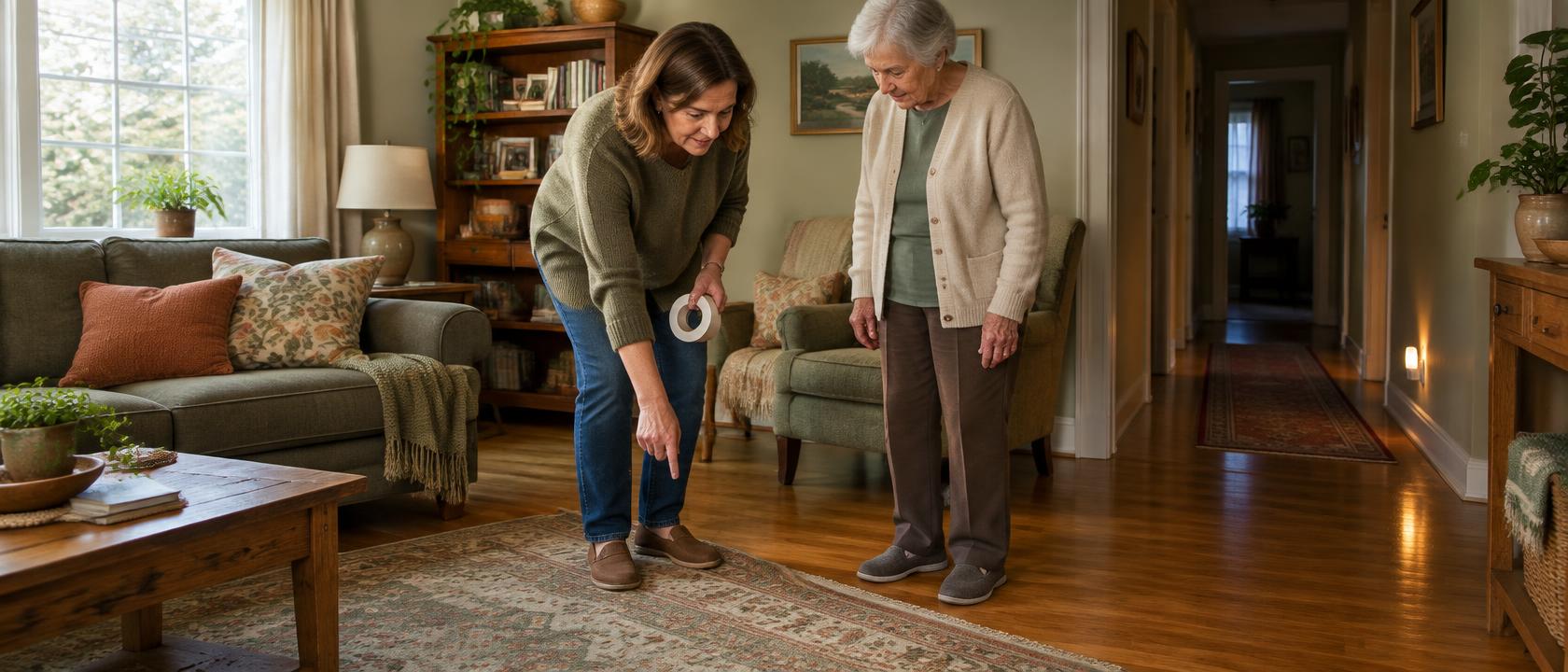
On the floors. Remove rugs, or use double-sided tape or a non-slip backing. Coil or tape cords next to the wall. The most common preventable hazard in a house is fixed with a roll of tape from a drawer.
On the stairs. Keep objects off the stairs. Fix loose handrails and make sure rails are on both sides. Most staircases have one rail, which works going down and does nothing coming up.
On the light. Put a lamp close to the bed and a nightlight on the path to the bathroom. Many falls happen at two in the morning, in the dark, by someone who did not want to wake anybody.
On the bathroom. Use a non-slip mat or strips in the tub or shower. Put grab bars next to and inside the tub, and next to the toilet. The inside one matters and gets skipped.
On the reaching. Keep frequently used things on lower shelves, about waist high. Moving dishes down one shelf removes the reason anyone climbs.
Add it up. Tape, a nightlight, a lamp, a bath mat, and an afternoon moving things. Under fifty dollars for most houses. In the July 2026 companion report on caregivers of adults 50 and older, 39 percent said they had made home modifications. You are not being dramatic. You are joining a large crowd who figured out the same thing.
Ten minutes, four rooms, almost no money
Floors and halls
Under $10
Remove or secure rugs; tape cords along walls; move everyday items to waist-high shelves.
Stairs and steps
Free to $
Keep stairs clear; tighten rails on both sides; secure carpet or add non-slip treads.
Bathroom
Under $40
Use a non-slip mat; add grab bars beside the toilet and beside and inside the tub.
Bedroom
Under $15
Put a lamp within reach; light the bathroom path; clear the floor to the door.
Measure
Number
Why it matters
Older adults who fall yearly
More than 1 in 4
The starting number.
Who tell their doctor
Less than half
The number that changes the conversation.
Hip-fracture hospitalizations
319,000
Each year among older people.
Sources: CDC, Facts About Older Adult Falls; Older Adult Falls Data; Check for Safety, 2017.
Save this · do it once, in order
The ten-minute walk-through
Take pictures with your phone. You are not fixing anything on this pass. You are only looking.
1
Start at the bed and walk to the toilet in the dark. Whatever you reach for, and whatever you cannot see, is the list.
2
Stand in every doorway and look only at the floor. Notice rugs, cords, thresholds, and anything near the stairs.
3
Put a hand out in the middle of each room. If there is nothing to hold within reach, note it.
4
Check the front and back steps for uneven height, wet leaves, missing rails, and missing light.
5
Ask: ‘Where in this house do you feel least steady?’ Then stop talking.
Walk it in the dark. Look only at the floor. Then ask.
The one job to hand to somebody else
If the person you care for has diabetes, or any condition that has taken some feeling out of their feet, stop cutting their toenails.
Not because you are doing it badly. Because the consequence of a small mistake is not a small consequence, and there is no way to know in advance which cut is the small one.
“If you mess up and clip a toe or you make a cut, then it doesn’t heal and that becomes a petri dish. I have seen people go septic from something just as simple.”
Sondra “Sam” Cradduck · Gerontologist
Feet are how people stay upright. Sore feet change how a person walks, and a person protecting a sore spot is a person whose balance has quietly changed. An ingrown nail is a fall risk. So is a callus, and so is the wrong shoe.
This job goes to a podiatrist. Ask whether coverage includes routine foot care; for people with diabetes and neuropathy it sometimes does. If neither is part of the picture, this is not your item and you can let it go.
Wherever you are standing in this
If you carry the daily care, the vigilance is not a personality trait. It is a job you were handed without a shift change. Every fix makes the house safer and lets you put down one small piece of that listening.
If you live nearby, the walk-through is yours. Do it, take pictures, and fix things on a different day. Take the outside steps, which are the ones nobody takes.
If you are the one far away, ask the question. You may be the person they answer honestly. Then find the local Center for Independent Living or Area Agency on Aging and ask about falls prevention classes.
Why this matters for the person you love
There is a cost to a fall nobody puts on the hospital bill. It is not the hip. It is the shrinking.
After a fall, people stop doing things. They stop going downstairs, then outside, then across the room without a plan. Each thing they stop doing takes strength with it, and less strength makes the next fall more likely.
That is why tape on a rug is not a small thing. You are not only preventing an injury. You are protecting the size of somebody’s life.
“Neither a person’s age nor disability status should ever be a barrier to being among loved ones in our homes and communities.”
Emily Ladau · Disability rights advocate
Your steady hand this week
You are about to go through somebody else’s house looking for the thing that could hurt them, and nobody has ever walked through yours.
50.6
The average age of a family caregiver of an adult. The person doing the lifting, driving, night shift, and walk-through is, on average, past fifty herself. Nobody is checking on the state of her stairs.
Source: AARP and National Alliance for Caregiving, Caregiving in the U.S. 2025, page 10
The small step
Fix one thing in your own house this week.
The bulb that has been out since spring. The box on your stairs. The rug that slides. Ten minutes. Probably free. One thing. You are allowed to be somebody worth keeping upright.
If you need somewhere to turn this week
Every resource is a government source, and none sells a grab bar. You do not have to carry this alone.
I verify these before every issue. If a link or program has changed, I will let you know.
Before you go
I want to say something about the fuss.
Somewhere this week you will suggest a change, and somebody will tell you that you are making a fuss, worrying too much, or treating them like they are old. It will land badly because you have carried this quietly for months and the first time you say it aloud you get told you are overreacting.
You are not overreacting. You have been listening to a hallway for a year.
The person who said it is not being cruel. They are defending something. Every change to that house is a sentence about what is happening to them, and they are not ready to read it yet. Both things are true and neither of you is wrong.
Do not win the argument. Do the small things that do not require permission, ask the question that lets them tell you the truth, and let the grab bar wait a month if it needs to. The rug does not require a conversation. Start there.
You have been the thing standing between that house and a bad night. You are allowed to let a nightlight take a shift.
With you in it,
C
Cherith
The Steady Hand
P.S. Next week we go from the things that cost nothing to the things that cost something: ramps, widened doors, a bathroom that works, and when you need a professional instead of a Saturday. We will cover which jobs are not do-it-yourself, where the money is—including a benefit for veterans—and the one room almost always worth doing first.
You have been listening to that house for longer than anyone knows. Some of that listening can be handed to a roll of tape, a nightlight, and a rail on the second side of the stairs. Put down what you can. You are not walking this alone.